At Sacred Heart, our History curriculum encourages children’s curiosity about the past and helps them understand how historical events have shaped the world they live in today.

Aims of the History Curriculum
The national curriculum for history aims to ensure that all pupils:
- know and understand the history of Britain as a coherent, chronological narrative, from the earliest times to the present day: how people’s lives have shaped this nation and how Britain has influenced and been influenced by the wider world.
- know and understand significant aspects of the history of the wider world: the nature of ancient civilisations; the expansion and dissolution of empires; characteristic features of past non-European societies; achievements and follies of mankind
- gain and deploy a historically grounded understanding of abstract terms such as ‘empire’, ‘civilisation’, ‘parliament’ and ‘peasantry.’
- understand historical concepts such as continuity and change, cause and consequence, similarity, difference and significance, and use them to make connections, draw contrasts, analyse trends, frame historically-valid questions and create their own structured accounts, including written narratives and analyses.
- understand the methods of historical enquiry, including how evidence is used rigorously to make historical claims, and discern how and why contrasting arguments and interpretations of the past have been constructed.
- gain historical perspective by placing their growing knowledge into different contexts, understanding the connections between local, regional, national and international history; between cultural, economic, military, political, religious and social history; and between short- and long-term timescales.
Our history curriculum draws upon several powerful sources of knowledge – this is our view on history:
Substantive knowledge– this is the subject knowledge and explicit vocabulary used about the past. Common misconceptions are explicitly revealed as non-examples and positioned against known and accurate content. Misconceptions are challenged carefully and in the context of the substantive and disciplinary knowledge.
Disciplinary knowledge– this is the use of that knowledge and how children construct understanding through historical claims, arguments and accounts. We call it ‘Working Historically.’ The features of thinking historically may involve significance, evidence, continuity and change, cause and consequence, historical perspective, and contextual interpretation.
Historical analysis is developed through selecting, organising and integrating knowledge through reasoning and inference making in response to our structured questions and challenges. We call this ‘Thinking historically’
Substantive concepts, such as tax, invasion and civilisation are taught through explicit vocabulary instruction as well as through the direct content and context of the study.
Our history curriculum draws upon prior learning, wherever the content is taught. For example, in the EYFS, pupils may learn about the past and present through daily activities, exploring through change, and understanding more about the lives of others through books and visitors as well as their own experiences. These experiences are drawn upon and used to position new learning in KS1.
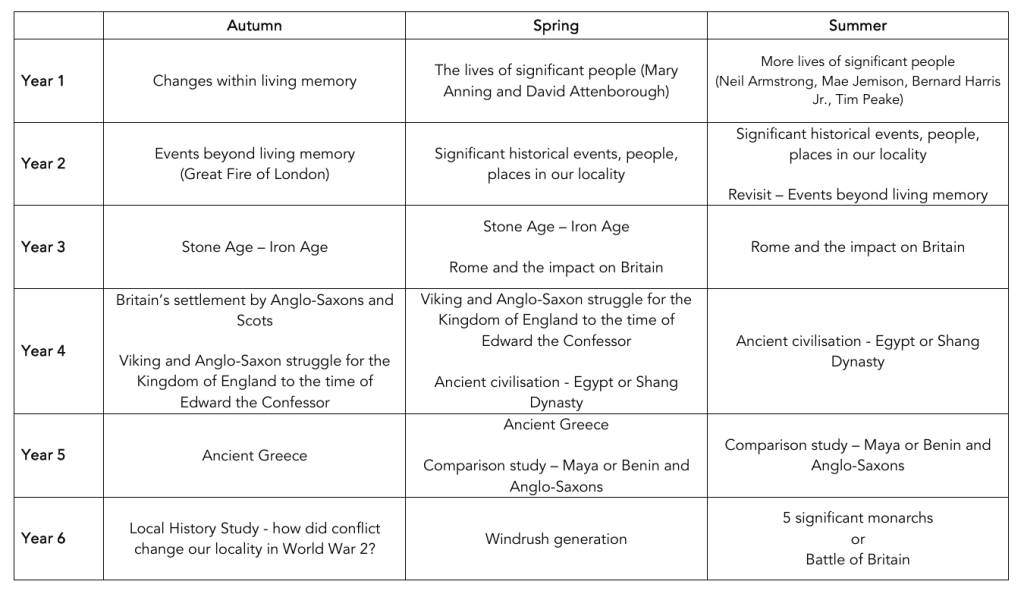
The structure is built around the principles of advancing cumulative knowledge, chronology, change through cause and effect, as well as making connections within and throughout periods of time studied.
The history curriculum is planned so that the retention of knowledge is much more than just ‘in the moment knowledge’. The curriculum strategically incorporates a range of modules that revisit, elaborate and sophisticate key concepts, events, people and places.
A guiding principle of the history curriculum, is that pupils become ‘more expert’ with each study and grow an ever broadening and coherent mental timeline. This guards against superficial, disconnected and fragmented understanding of the past. Specific and associated historical vocabulary is planned sequentially and cumulatively from Y1 to Y6. High frequency, multiple meaning words (Tier 2) are taught alongside and help make sense of subject specific words (Tier 3). Each learning module in history has a vocabulary module with teacher guidance, tasks and resources.
Year 7 - Life After Sacred Heart
We are part of the Mater Christi Trust and work closely with Secondary Schools in our family. We want to ensure that all children have a successful and positive transition between Key Stage 2 and 3 and are prepared for their adult life as well.
We ensure that the children focus on a wide range of historical knowledge that will assist them in Key Stage 3. This will also develop their confidence in this subject area which will help them connect with new students as they transition into Year 7.
We focus on their oracy skills during all of our history lessons, projects and field trips which ensures children are able to fully participate as part of a group in a larger setting.
Their time at Primary school ensures that they are fluent in and have mastered the knowledge and skills needed for the Key Stage 2 curriculum and are ready for accessing the Key Stage 3 curriculum in depth.