We are passionate about Science here at Sacred Heart and we believe that all children are born scientists with their curious minds and their enthusiasm for knowledge.
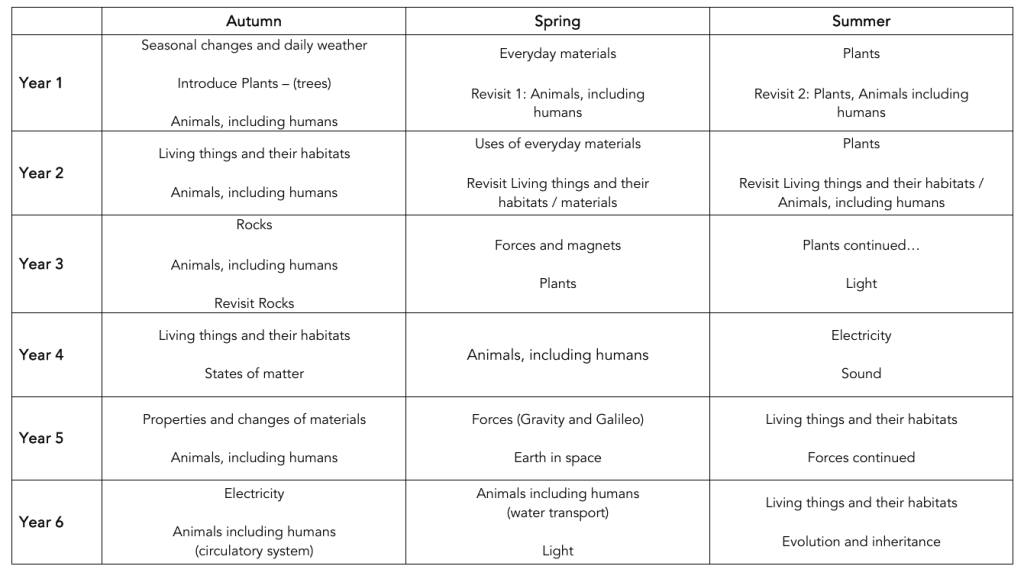
Cusp Science pays close attention to guidance provided by the National Curriculum sequence and content. It is infused with evidence-led practice and enriched with retrieval studies to ensure long-term retention of foundational knowledge. The foundations of CUSP science are cemented in the EYFS through learning within the Natural World, and People, Culture and Communities.
Our ambitious interpretation of the National Curriculum places knowledge, vocabulary, working and thinking scientifically at the heart of our principles, structure and practice.
- Substantive knowledge– this is the subject knowledge and explicit vocabulary used to learn about the content. Common misconceptions are explicitly revealed as non-examples and positioned against known and accurate content. In science, an extensive and connected knowledge base is constructed so that pupils can use these foundations and integrate it with what they already know. Misconceptions are challenged carefully and in the context of the substantive and disciplinary knowledge.
- Disciplinary knowledge– this is knowing how to collect, use, interpret, understand and evaluate the evidence from scientific processes. This is taught. It is not assumed that pupils will acquire these skills by luck or hope. Pupils construct understanding by applying substantive knowledge to questioning and planning, observing, performing a range of tests, accurately measuring, comparing through identifying and classifying, using observations and gathering data to help answer questions, explaining and reporting, predicting, concluding, improving, and seeking patterns. We call it ‘Working Scientifically.’
Scientific analysis is developed through IPROF criteria. We call it ‘Thinking Scientifically.’
- identifying and classifying
- pattern seeking
- research
- observing over time
- fair and comparative testing
- Substantive concepts include concrete examples, such as ‘plant’ or more abstract ideas, such as ‘biodiversity’. Concepts are taught through explicit vocabulary instruction as well as through the direct content and context of the study.
A guiding principle of Science is that each study draws upon prior learning. For example, in the EYFS, pupils may learn about The Natural World through daily activities and exploring their locality and immediate environment. This is revisited and positioned so that new and potentially abstract content in Year 1, such as Animals, including humans, is related to what children already know. This makes it easier to cognitively process. This helps to accelerate new learning as children integrate prior understanding.
Our science curriculum is organised into three distinct subject domains: biology, physics and chemistry. Where inter-disciplinary concepts are encountered, such as the particle model, these are taught explicitly and connected across science domains.

Through studying CUSP science, pupils become ‘a little more expert’ as they progress through the curriculum, accumulating, connecting and making sense of the rich substantive and disciplinary knowledge.